

Please note: These are guidelines for non-Akrobat Trampolines. For Akrobat trampolines, we can get you an exact match and proper fit every time. Start by identifying your product and reach out to that manufacturer as most enclosures will not fit other brands.
Ordered a new trampoline net, but it sags or doesn’t fit? You’re not alone. Whether you’re replacing a torn net or upgrading your setup, the issue often comes down to incorrect measurements. Measuring the mat instead of the frame (or guessing the size) can lead to mismatches.
Trampoline nets aren’t one-size-fits-all. A net that’s too big leaves gaps, while one that’s too tight can damage your poles. Even slight frame warping makes things trickier.
With over 20 years of experience, we know precision matters. This guide will show you exactly how to measure your trampoline right, ensuring a perfect fit and safe bounce.
Let’s get it right the first time.
Why Getting Net Measurements Right Really Matters
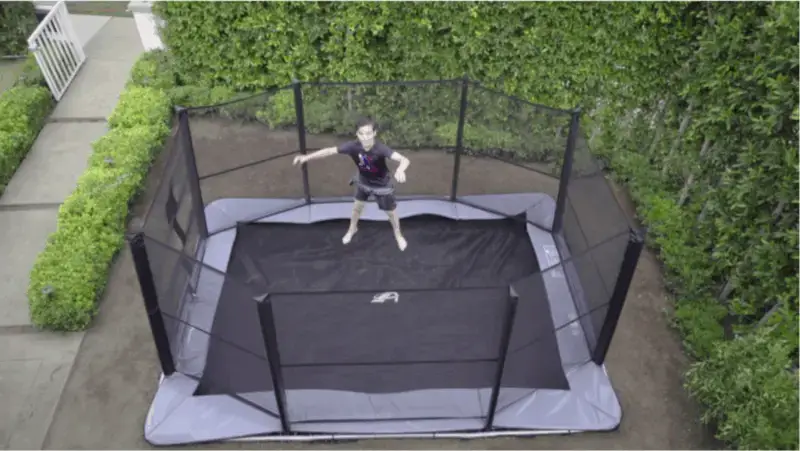
When a trampoline net doesn’t fit properly, the entire enclosure system is compromised.
An oversized net might seem like a forgiving option, after all, a little extra slack can’t hurt, right? Wrong. A net that’s too big will sag under pressure. It won’t maintain the tension needed to catch a jumper mid-bounce, and that slack can become a trap, literally. Kids can get tangled, fall between the net and frame, or even slip under the padding. I’ve personally seen nets billow outward like sails in the wind. That’s not protection. That’s a hazard.
Undersized nets are no better. You’ll find yourself stretching it over poles it was never meant to reach, putting constant stress on the net fabric and enclosure system. This weakens the structural integrity and can cause the net to snap at its weakest points. Plus, when tension is uneven (tight in some places, loose in others) you’re creating unpredictable bounce zones that shift every time someone lands.
A correctly sized enclosure should form a tight, resilient barrier that absorbs energy and redirects momentum. Anything less, and you’re not protecting your jumpers, you’re gambling with their safety.
The 3 Key Things You Must Measure for a Trampoline Net
Before you hit “Buy Now” on that new safety net, take a breath and grab a measuring tape. You need three measurements, not one. And no, eyeballing it won’t cut it.
Here’s a quick checklist for your measuring mission:
| What to Measure | How to Measure It | Tools Needed |
| Frame Diameter | Across the widest part of the metal frame, not the jumping mat | Tape measure |
| Pole Count & Shape | Count vertical poles + identify shape (straight, curved, arched) | Your eyes + basic notes |
| Pole Height | From top of metal frame to top of each enclosure pole | Tape measure, flat ground |
1. Frame Diameter (Not Mat Size!)
This is the most frequent (and costly) mistake we see people make. They measure the jump mat. But replacement nets are manufactured to fit the frame diameter, not the fabric.
For round trampolines:
- Measure from outside edge to outside edge of the metal frame, across the widest point.
- Take one measurement across the 3 o’clock to 9 o’clock position.
- Take a second from 12 o’clock to 6 o’clock.
- Average the two numbers, frames often warp over time, and this helps correct for distortions.
For rectangular trampolines:
- Measure both the length and the width of the outer frame.
- Record each separately; your net must match both dimensions.
📏 Pro Tip: Always measure with the trampoline fully assembled and on level ground. Otherwise, you’ll be chasing numbers that don’t reflect real-world tension and geometry.
2. Pole Count and Configuration
This is where things really get specific and where a lot of net returns start. Most enclosure nets are manufactured to match both diameter and the number of poles. If your trampoline has 6 poles but you buy a net made for 8, it simply won’t fit correctly. Tension will be uneven, gaps will form, and you’ll be left with an unsafe enclosure.
Take a slow walk around your trampoline and count every vertical enclosure pole. Then, note the style:
- Straight poles – popular on standard outdoor trampolines.
- Curved poles – arch slightly outward at the top.
- Arched or angled poles – flare out or up for extra bounce clearance.
- Top-ring systems – support a circular frame at the top of the net, usually tensioned via clips or sleeves.
🧠 Expert Note: A net designed for curved poles will not sit properly on straight ones.
3. Pole Height
Here’s a measurement that gets overlooked until it’s too late.
Grab your tape measure and start at the top of the trampoline’s metal frame, where the springs connect. Measure vertically to the top of the enclosure pole: this is your pole height.
Pole height determines net height compatibility. A 6-foot pole needs a net built to stretch that tall and fasten securely without over-tensioning or drooping.
- For younger kids, standard height nets are often fine.
- For teens, adult use, or trick training, you’ll want a taller net for added security on high bounces.
⚠️ Watch Out: Not all nets list pole height compatibility in obvious ways. Akrobat includes pole height specs and tension fit ranges for every Akrobat enclosure system because we build our gear with real-world jumping in mind.
📦 Bottom Line: You wouldn’t buy shoes without knowing your size. Don’t buy a trampoline net without these three numbers:
- Frame diameter
- Pole count & shape
- Pole height
Enclosure Net Types: Which One Do You Have?
You’ve got the frame measurements. You’ve counted your poles. Now comes the part that trips up even seasoned trampoline owners: knowing which net style your trampoline uses.
Inner Net vs. Outer Net
Start with where the net attaches in relation to the springs and padding. This tells you whether you need an inner net or an outer net and yes, it matters.
✅ Inner Net
- Attaches inside the spring pad, connecting directly to the jumping mat or inner frame ring.
- Offers maximum containment: users can’t land on or near the springs, which reduces risk of foot entrapment or slipping between pads.
- Ideal for younger kids or cautious parents looking for maximum protection from every angle.
💡 Safety First Insight: If your trampoline sees a lot of use from smaller children or early jumpers, inner nets give you peace of mind. They create a fully walled-off bounce zone.
✅ Outer Net
- Attaches outside the spring pad, often to the top of the frame or outer pole brackets.
- Provides more usable jumping space, since the jumper can use the full surface of the mat including areas near the springs.
- Typically seen in setups designed for older kids, teens, or adults who want freedom of movement.
💡 Performance Note: Outer nets are popular among freestyle jumpers or those training for sports because they allow full mat use. But that also means spring exposure if padding shifts.
🛠 How to Tell What You Have:
Take a look at your current setup. If the net wraps around inside the padding, you’ve got an inner net. If it connects around the outside of the frame or padding, you’re using an outer net.
Top-Ring Nets vs. Hooked Nets
Next, check how the net is tensioned and supported at the top.
✅ Top-Ring Nets
- Use a flexible tension ring (typically fiberglass or steel) threaded through a fabric sleeve at the top of the net.
- This creates a firm circular shape at the top, keeping the net upright and tight like a tent pole arch.
- Requires curved or angled poles to create clearance for the ring and allow vertical alignment.
💡 Engineering Insight: These systems distribute tension evenly and maintain shape better over time but only if you’ve got the right pole structure. Trying to install a top-ring net on straight poles will lead to bowing, stress, or collapse.
✅ Hooked or Sleeve Nets
- These attach to the top of each pole via individual hooks, straps, or sleeves. no ring required.
- Popular on more traditional trampolines with straight vertical poles.
- Slightly easier to install and typically more budget-friendly.
🔍 Why This All Matters
Imagine trying to fit a round net on a square frame: it won’t end well. Same goes for net styles. Choosing the wrong type will give you gaps, tension failures, or a net that simply won’t install at all.
We make it easy: each net product clearly states whether it’s designed for inner or outer attachment, top-ring support or hook system. And our team’s always ready to help verify compatibility because once the trampoline’s up, we want you focused on the jumping, not the adjusting.
What to Do If You’re Still Not Sure
Even with all the right measurements in hand, trampoline sizing can still feel a little… fuzzy. Maybe your frame’s a little warped from years of backyard use. Maybe you’ve counted seven poles, but the new net you’re eyeing is designed for six or eight. Maybe you inherited the trampoline and don’t even know the brand.
Here’s the truth: it’s okay to need help as long as you get it from someone who knows what they’re talking about.
Use a Net Compatibility Guide (or Ask the Manufacturer)
This is exactly where premium brands separate themselves from the big-box imports. Akrobat has helped thousands of customers get the exact right fit. Not just by chance, but by system.
Our team uses visual compatibility guides, part lookup tools, and yes, actual humans to walk you through what will fit and why. Whether you need help identifying an older Akrobat frame, matching net specs to a pole configuration, or confirming if a certain setup can handle an upgrade. We’re here to make sure the answer is right. Because once that net goes up, there’s no room for second-guessing.
Every trampoline we engineer is designed for long-term use, structural integrity, and safe performance under tension. That means tighter tolerance ranges. Cleaner fittings. Real-world bounce scenarios considered in every part spec. That’s what you get when a company is obsessed with doing things the right way.
📞 Reach out. We’ve got you covered.
Whether it’s by email, phone, or through our customer fit-check process, we’ll help you get it dialed in.
Measure Once, Fit Right Forever
Measuring your trampoline for a new net isn’t hard. It doesn’t require power tools, engineering degrees, or second guesses. But it does require precision and a little patience. Get it right the first time, and you’ll avoid the headaches of returns, the risks of sagging nets, and the uncertainty that comes with buying the wrong gear for the people you care about most.
So take the time. Measure your frame. Count your poles. Confirm your setup. And when you’re ready to get the best-fitting net you’ve ever owned, you can find us here.
🧭 Bookmark this guide. Share it with a neighbor. Or send it to that friend whose trampoline net has seen better days.
